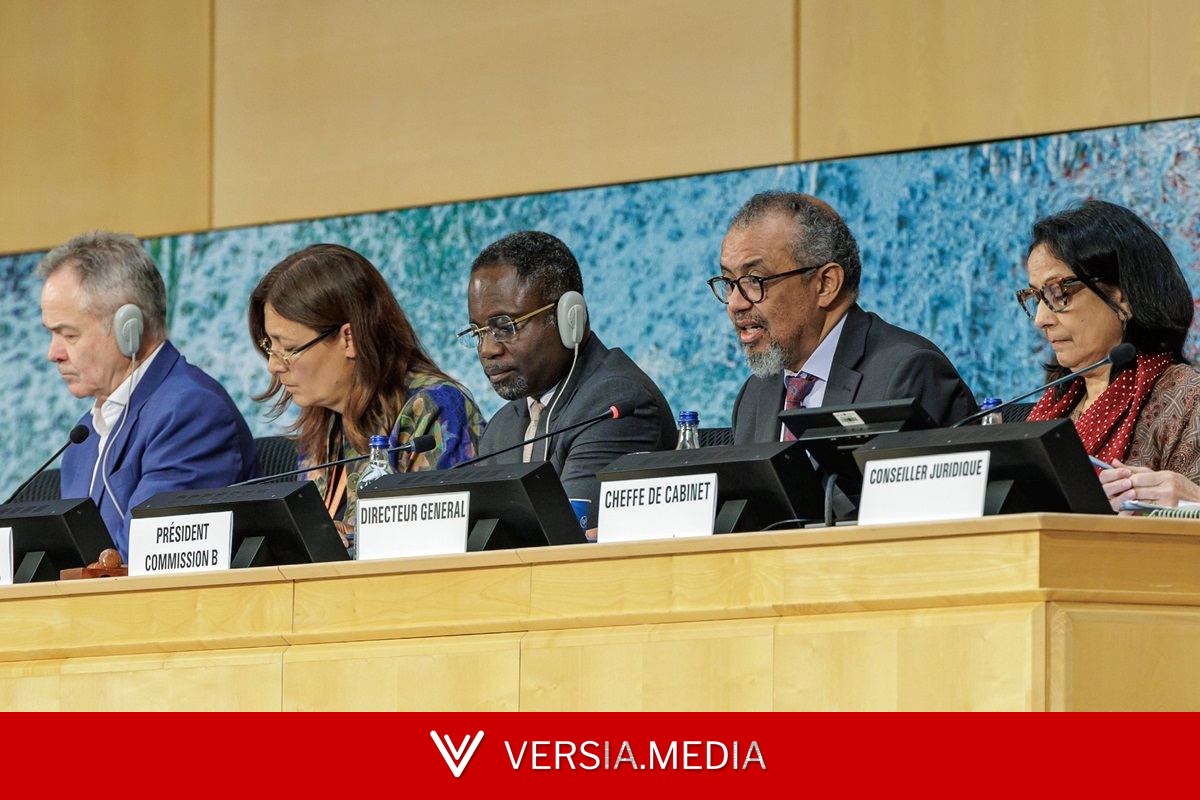
Member States launch joint initiative to back global health architecture reforms
Today, the World Health Assembly decided to create a collaborative process led by Member States, hosted by WHO, and involving global health partners to support changes to the global health architecture.
The Assembly agreed that this process should produce options and recommendations for reforming the global health architecture to address the unique and shared needs of countries and communities, maximizing access, impact, and fairness. The effort should build upon existing reform initiatives and relevant aspects of the UN80 Initiative.
Member States voiced robust backing for WHO’s central role in convening and setting norms, stressing that although the process will be Member State-driven, it should move forward jointly with global health initiatives and UN partners, including meaningful involvement of key stakeholders such as civil society and youth.
The proposal adopted by the Assembly acknowledged the health gains achieved by the current global health architecture over recent decades, such as in disease control, global standards and norms, and more effective joint responses to cross-border health threats. However, Member States pointed out that the global health architecture had failed to keep up with the changing and evolving global landscape. This included the growth of national health sovereignty and regional capabilities; shifting disease patterns and health risks; rapid advances in science, AI, and digital technologies; and reductions in health funding.
Furthermore, the global health environment had grown more intricate due to the increase in the number of health actors, leading to power imbalances, fragmentation, and duplication, which have affected country ownership and leadership.
The Health Assembly asked the WHO Director-General to present a final report containing options and recommendations for transforming the global health architecture to next year’s World Health Assembly.
Related links
https://apps.who.int/gb/ebwha/pdf_files/WHA79/A79_24-en.pdf
Reforming the global health architecture
Member States review communications from the UN Secretary-General as depositary of the WHO Constitution
The World Health Assembly, convening in Committee B under the sub-item “Communications of the United Nations Secretary-General as depositary of the Constitution of the World Health Organization,” examined several proposals concerning Argentina’s notification of withdrawal from the World Health Organization and reached a consensus on a compromise text.
The Assembly, which is tasked under the WHO Constitution with addressing such matters, acknowledged Argentina’s communication and determined that, while WHO will always welcome Argentina’s full engagement in the Organization’s work, no further action is advisable at this time.
Related link
https://apps.who.int/gb/ebwha/pdf_files/WHA79/A79_BCONF4-en.pdf
Countries approve first-ever Assembly resolution on stroke
Today, delegates endorsed the first-ever World Health Assembly resolution on stroke, entitled “Reducing the burden of stroke: strengthening prevention, acute care, rehabilitation and health-system readiness.” Proposed by Egypt and jointly sponsored by Chile, Georgia, Palestine, Paraguay, and Tunisia, the resolution demonstrates broad representation across WHO regions.
Its adoption comes at a critical time. Over the past 20 years, the lifetime risk of stroke has risen by 50%, with 1 in 4 adults expected to suffer a stroke in their lifetime. In 2021, stroke ranked as the third leading cause of death and disability worldwide, with an estimated 93.8 million cases, including 11.9 million new cases globally.
The resolution calls for enhanced national and global efforts to lessen the burden of stroke through prevention, acute care, rehabilitation, and improved health system readiness. It also strengthens reporting accountability via the WHO Global NCD action plan 2023–2030 and the Intersectoral global action plan on epilepsy and other neurological disorders 2022–2031.
Related links
Reducing the burden of stroke: strengthening prevention, acute care, rehabilitation and health system readiness (EB158.R4)
Global action plan for the prevention and control of noncommunicable diseases 2013–2030
Intersectoral global action plan on epilepsy and other neurological disorders 2022–2031
Political declaration of the fourth high-level meeting of the General Assembly on the prevention and control of noncommunicable diseases and the promotion of mental health and well-being
Global strategy on digital health 2020–2025
Member States push forward smart global safety monitoring of medicines and vaccines
In a key step toward improving access to safe and effective medicines and vaccines, the Assembly today approved a resolution to bolster pharmacovigilance systems worldwide. The resolution recognizes risk-based prioritization of medicine and vaccine safety monitoring as a vital component of patient safety, resilient health systems, and efforts to achieve universal health coverage.
The resolution responds to lessons from the COVID-19 pandemic and other health emergencies, which highlighted the need for rapid detection and management of safety signals related to medicines, vaccines, and medical devices. It also points to growing global challenges, such as fragmented monitoring systems, uneven regulatory capacities, and the spread of mis- and disinformation that can erode trust in science and public health measures.
Member States committed to updating national pharmacovigilance systems, integrating patient reporting mechanisms, enhancing workforce capacity, and boosting collaboration at national, regional, and global levels. The resolution also underscores the growing potential of digital technologies, real-world data, and artificial intelligence to improve safety surveillance and regulatory decisions, while stressing the importance of ethical considerations, transparency, data governance, and public trust.
WHO will continue to develop global guidance and technical tools on smart pharmacovigilance, assist countries in strengthening regulatory and workforce capacities, and promote greater international collaboration and information sharing. Progress in implementing the resolution will be reported to future World Health Assemblies between 2028 and 2032.
Related links
A79/5 and EB158.R5
The global smart pharmacovigilance strategy
Regulation and safety/Pharmacovigilance
New global strategy agreed to advance life-saving emergency, critical, and operative care
The Assembly approved a groundbreaking new Global Strategy for Integrated Emergency, Critical and Operative (ECO) Care 2026–2035, offering a roadmap for countries to strengthen health systems and deliver more timely, affordable, and quality ECO services across all levels of care at scale.
Conditions addressable by ECO span all major health areas, cover the top global causes of death and disability, and account for an estimated 38 million deaths and 1.3 billion disability-adjusted life years annually. Effective, integrated ECO services are essential to mitigate the impact of growing public health risks, including outbreaks, conflicts, disasters, and climate-related events.
However, many countries face persistent challenges, such as health worker shortages, inadequate support systems, limited skills and equipment, and gaps in service design and delivery that lead to delayed recognition of illness and disrupted continuity of care.
WHO will set the direction and priorities for global ECO advocacy, partnerships, and networks, articulate evidence-based policy options, and provide Member States with technical and strategic support. WHO will, in consultation with Member States, develop an action plan with targets for implementing the strategy by the end of 2026.
Related links
EB158/11, provisional agenda item 9, Draft global strategy for integrated emergency, critical and operative care, 2026–2035
WHA76.2, Agenda item 13.1, Integrated emergency, critical and operative care for universal health coverage and protection from health emergencies
Acute Care Action Network (ACAN)
Assembly backs stronger access to diagnostic imaging through teleradiology
Today, Member States endorsed a resolution to scale up efforts to strengthen equitable access to essential diagnostic imaging through teleradiology. Imaging is a key part of health care for the timely detection, diagnosis, monitoring, and management of communicable and noncommunicable diseases, trauma, and other medical conditions, as well as for maternal and child health care. However, many communities—especially those in remote or underserved areas—still face major gaps in access to radiology services due to shortages of trained imaging professionals and limited infrastructure.
The resolution recognizes teleradiology—the secure transmission and remote interpretation of medical images—as a practical and cost-effective way to expand access to expert diagnostic services, strengthen health systems, and advance universal health coverage and health equity. It also highlights the growing role of digital health technologies and artificial intelligence in radiology, while emphasizing the need for strong governance, patient safety, ethical standards, data protection, and clinical oversight.
Through the resolution, Member States agreed to integrate teleradiology into national health and digital health strategies, strengthen regulatory, procurement, and workforce capacities, invest in secure digital infrastructure, and promote regional and international collaboration.
WHO is also asked to provide technical assistance, develop normative guidance, and facilitate global cooperation and knowledge-sharing to support the safe, ethical, and effective implementation of teleradiology services, particularly in developing countries and underserved settings.
Related links
A79/5 and EB158.R3
Resolutions WHA71.7 (2018) on digital health
Resolution WHA76.5 (2023) on strengthening diagnostics capacity
Strengthening medical imaging
Global strategy on digital health 2020–2025
Countries adopt landmark resolution on precision medicine, putting equity at the center
The Assembly has approved a landmark resolution on precision medicine, setting a global path toward more targeted, personalized, and equitable health care.
Precision medicine uses clinical, molecular, and genomic data to guide prevention, diagnosis, and treatment—helping ensure the right care reaches the right person at the right time, improving outcomes and efficiency.
Member States emphasized that precision medicine offers significant potential to accelerate progress toward universal health coverage. Evidence shows clear benefits, from improved survival in cancer through targeted therapies, to quicker diagnosis of rare diseases and safer, more effective prescribing, enabling more targeted and effective care.
However, countries highlighted major gaps. Many low- and middle-income settings face limited laboratory capacity, shortages of skilled professionals, and under-representation in genomic data, raising concerns about widening inequities if access is not addressed.
The resolution asks WHO to develop a global strategy on precision medicine, if deemed necessary after a mapping of existing guidance. WHO is also requested to provide guidance and capacity-building, develop a framework for self-assessment of country readiness to implement precision medicine, and create a platform for international collaboration to support country implementation.
Discussions highlighted both rapid scientific progress and the risk of unequal access. The final text reinforces ethical data use, sustainability, and alignment with universal health coverage goals.
Looking ahead, WHO will support Member States in turning commitments into action and report progress to future World Health Assemblies.
Related links
Precision medicine: a path towards targeted, personalized and equitable care (resolution EB158.R2)
Precision medicine: a path towards targeted, personalized and equitable care (Executive Board document and full draft text) Financial Implications: EB158/CONF./6 Add.1, which outlines the estimated $2.98 million budget required for the Secretariat to implement the resolution's objectives. [1, 2, 3, 4]
Resolutions on health in the occupied Palestinian territory and countries in the Middle East
On 21 May, delegates agreed to continue reporting on health conditions in the occupied Palestinian territory (oPt), including east Jerusalem, to the next World Health Assembly, through Executive Board draft resolution EB158.R6.
The decision follows a report by the Director-General highlighting a worsening humanitarian crisis in oPt, with healthcare services under severe strain. The report points to repeated attacks on healthcare, shortages of medicines, supplies, and fuel, and restricted access to services, despite a ceasefire announced in October 2025.
In Gaza, health sector losses are estimated at US$ 6.78 billion, including US$ 1.39 billion in infrastructure damage. A total of 1,947 attacks on healthcare were recorded across the territory, including 986 in the West Bank, since October 2023.
Despite these challenges and limited funding, WHO continues to work with partners to sustain life-saving services and support early recovery efforts.
Related links
Report by the Director-General A79/12
Executive Board draft resolution EB158.R6
Report by the Director-General A79/11
Draft decision A79/B/CONF./1
Following discussions on the ongoing escalation in the Middle East, delegates approved a resolution on the public health impact in Gulf Cooperation Council countries and Jordan.
Related link
Draft resolution A79/A/CONF./4
Editor's note
This daily update was corrected on 23 May to remove the section on radiation and health.